My first day back at The Box after Lockdown 2, and my first day in a new- to-me gallery.

I could give you the official description of Port of Plymouth 1 but yesterday for an hour or so I had a unique experience. The gallery was almost empty and I had the chance to explore it unencumbered with any responsibility for the well being of visitors.
The portrait above is of an anonymous fisherman, he is the human face of the character of this gallery. The gallery yesterday represented to me the biography of the city. Port of Plymouth 1 tells the story, the basis almost, of every other gallery in the museum. The sort of thing that might be written on the back of a funeral service booklet to give an over view of the deceaseds life. Of course Plymouth has not died and under current circumstances enjoys relatively good health.
I deliberately chose a man’s photograph because the gallery has a woman’s voice. Dawn French narrates two audio visual presentations within Port 1 and while you are in the space you are never very far away from her voice. This is a brilliant piece of gender balance because inevitably Port 1 is for the most part a man’s world. Not because women played no part in the history of Plymouth but because history has traditionally sidelined women’s contribution. It is only really the 20 th Century exhibits that begin to truly reflect the importance of women to the city.

As you enter Port of Plymouth 1 there is a massive 3D screen showing a film presentation of the developmental history of Plymouth. The film is one of the exhibits narrated by Dawn French. Currently with Covid-19 restrictions only about twelve people can view it at any one time, with so few people it is hard to gauge the impact but later in my morning a whole school group of about 40 watched it together and the impact on them as a large group was remarkable, when the museum can open as normal this will be a memorable group activity.
@theoldmortuary we are in the process of moving home. It was a little bit strange to view our proposed new location as history evolved over it and in the WW2 era bombs landed very close.

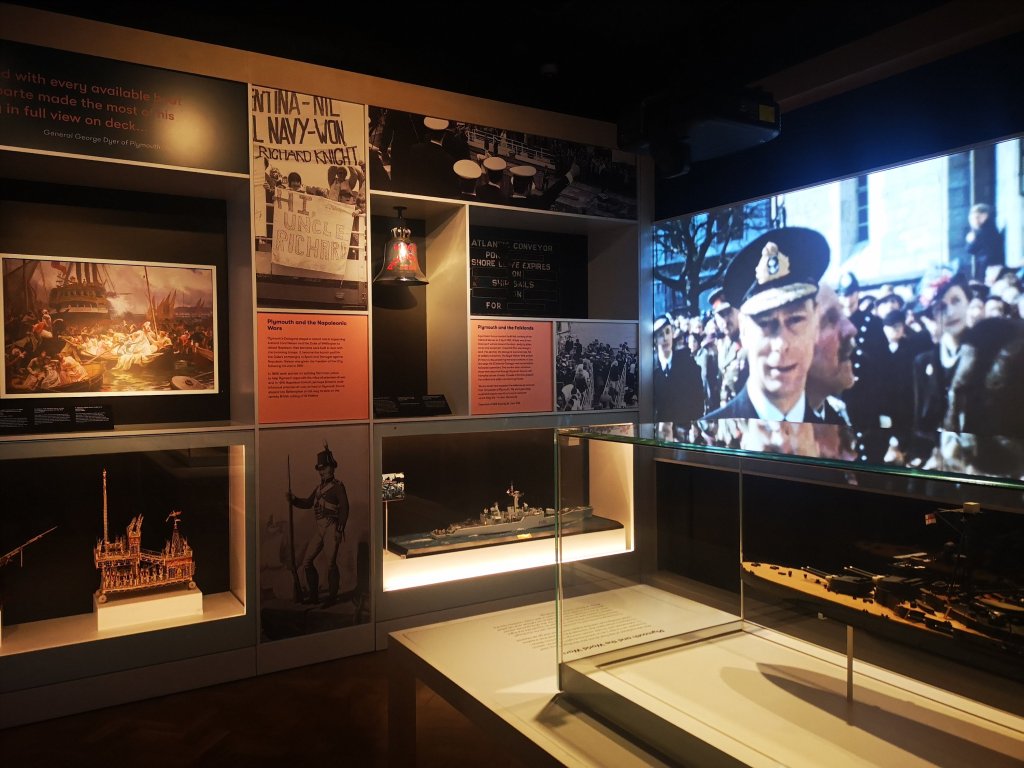
Ambient Lighting in Port of Plymouth 1 is subdued but the lighting of each exhibit is so beautifully done that even when it is full of people ( a future aspiration) it is really easy to concentrate and understand the significance of each exhibit.
One historic artifact was simple but poignant.

The Falklands Conflict left a big mark on the recentish memory of Plymouth

This is the point that pondering has to stop, just like the Dockyard Gate photo above, the visitors started to arrive. There is loads more to talk about but visitor safety and smiling took over my time.