


Spring really is dragging its heels a bit. Sundays tease us with some sun but then the rain and the greige return. I am lucky that every day I get to visit an art exhibition first thing in the morning. I get to appreciate the dank beauty of a West Country winter by checking out Clare Rogers Dartmoor trees; whilst being grumpy about the misery of a dank spring.
I’ve even made casseroles and meat pies this week like a woman trying to perk up January.
There is a point to my wet weather moaning. I deliberately took a different route home yesterday to maximise walking in less exposed, weather whipped paths . I came to these building works boards and actually read the notice attatched.
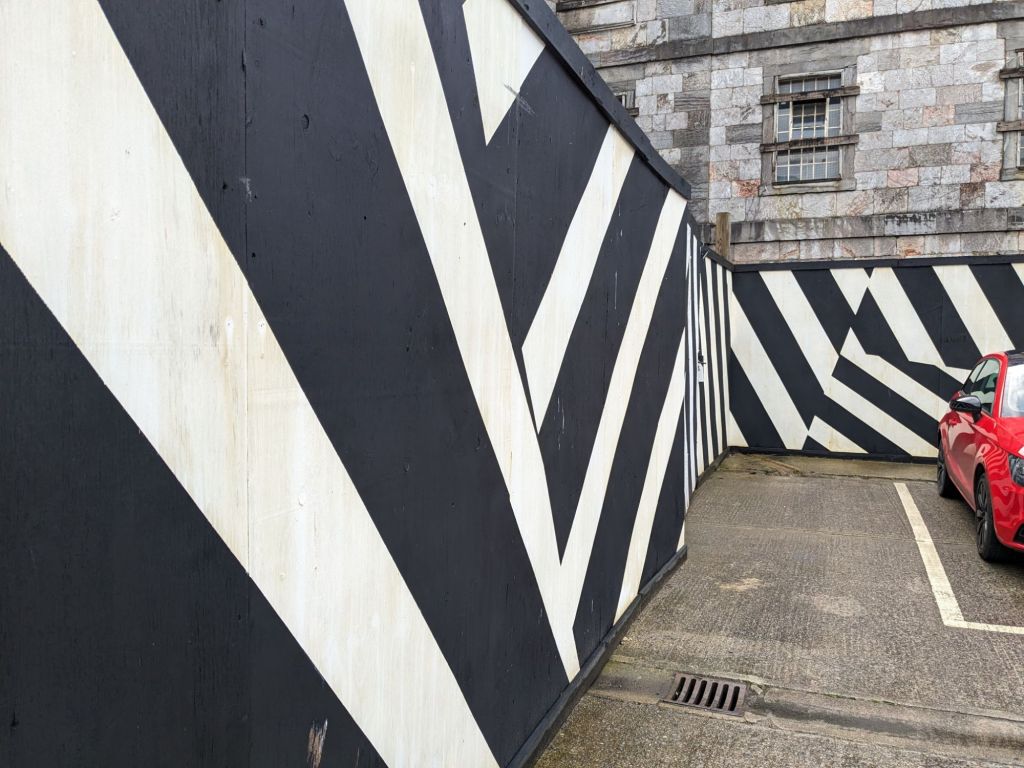
Suddenly my grey old day was filled with Razzle Dazzle.

Dazzle paint was developed by the artist Norman Wilkinson and used on ships in the First and Second World Wars to confuse the eyes of the enemy.
Dazzle isn’t camouflage: it was realised very early on that it would be impossible to give a ship one paint scheme that would hide it in all the environments it would sail through. Instead, the geometric shapes made it difficult to visually assess the class, distance, position and movement of ships, thereby making it difficult to Thus the term “Dazzle” or “Razzle Dazzle” was used to target. describe the paint schemes. The marine artist Norman Wilkinson came up with the theory that the appearance of a ship could be altered by painting it in high contrast colours. Angular lines were used to make the work of a range finder difficult.
The dazzle schemes played with light and dark, the concept of countershading being used: parts of the ship that would naturally be shaded- under guns and overhangs – were painted bright white so as to hide the shape of the shadow. The same principle was used in reverse for parts that were usually cast in light. Tops of gun barrels would be painted in darker shades than the bottoms. White was usually used for masts because white would blend in with the sky in many situations. The decks of ships were also painted, to disguise it when the ship was listing heavily. All parts of ships tended to be
painted, from funnels to guns to boats.
Dazzle-painted ships constituted the world’s largest public art and design display ever assembled. It’s legacy lives on and around the world Dazzle has been applied to buildings, cars, clothes and shoes, and continues to influence art, design and fashion. Investigations continue as to how Dazzle can be adapted for practical uses in non-military settings.
All fascinating stuff and thrillingly I get to use a new word in my next sentence. Thanks Google.

Norman Wilkinson was not just a camoufleur.

He also designed travel posters, which I love

All in all a rainy day with unexpected purpose.
Clare Rogers is exhibiting at Ocean Studios until and including Easter Sunday.

 theoldmortuary.design
love the look of that tree and you never know when you’ll stumble across a bit of razzle dazzle. I had no idea about this history
LikeLike
Me neither, I have just had a look at dazzle painted warships on google images. The effect is extraordinary.
LikeLiked by 1 person